

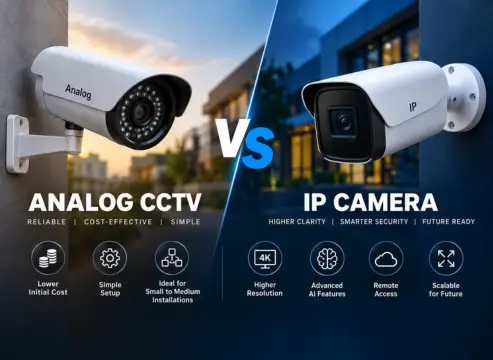
Every surveillance buyer in India runs into this question sooner or later: should you install an IP camera vs analog CCTV system? Both technologies capture and record video, but the way they do it — and what that means for image quality, cost, and features — is fundamentally different. This guide brings together everything you need to know in one place: how each system works, a side-by-side comparison, a buying checklist based on your property type, the 2026 certification rules Indian buyers must know about, and a shortlist of IP cameras currently available to Indian consumers.
IP cameras digitise video inside the camera and send it over a network (Ethernet or Wi-Fi) to an NVR or the cloud, giving higher resolution, remote viewing, and AI-based analytics. Analog CCTV cameras send a raw analog signal over coaxial cable to a DVR, cheaper upfront and simple, but limited on resolution and smart features. For a new installation, an IP camera system is the better long-term choice; analog still makes sense when you’re extending an already coax-wired site on a tight budget.
What Is an Analog CCTV Camera?
An analog camera captures video and sends it as a continuous analog signal down a coaxial cable to a Digital Video Recorder (DVR). The DVR is where the actual digitisation, compression, and storage happen — the camera itself does very little processing. A separate cable is usually needed to power the camera, so a typical analog installation runs two cables to every camera: one for video, one for power.
Analog technology has evolved well beyond the grainy footage most people associate with it. Newer HD-over-coax formats — HD-TVI, AHD, and HD-CVI — can push resolutions up to 5MP over the same coaxial cabling used for decades, which is why analog is still relevant for retrofits where the cable runs are already in place.
What Is an IP Camera?
An IP (Internet Protocol) camera, also called a network camera, digitises and compresses video right inside the camera before sending it over a standard network — typically via a single Ethernet cable using Power over Ethernet (PoE), or over Wi-Fi. Because the camera itself does the processing, it can run advanced features on-device: motion and person detection, facial recognition, line-crossing alerts, and two-way audio.
Recording happens on a Network Video Recorder (NVR), a local microSD card, or cloud storage, depending on the model. Since the camera is already a network device, most IP cameras also support remote viewing through a mobile app without any extra hardware.
IP Camera vs Analog CCTV: Key Differences at a Glance
|
Parameter |
Analog CCTV Camera |
IP Camera |
|
Signal type |
Analog video signal |
Fully digital video signal |
|
Cabling |
Coaxial cable for video + separate power cable |
Single Ethernet cable (PoE carries data + power), or Wi-Fi |
|
Recorder |
DVR (Digital Video Recorder) |
NVR (Network Video Recorder) or cloud/local storage |
|
Typical resolution |
Up to 5MP on modern HD-over-coax (HD-TVI/AHD/CVI) models |
2MP to 4K and beyond |
|
Remote viewing |
Limited; needs the DVR connected to the network |
Built-in; live view from a mobile app anywhere |
|
Smart features |
Basic motion alerts on newer models only |
AI person/vehicle detection, facial recognition, line-crossing alerts, two-way audio |
|
Installation |
More cabling; harder to extend once walls are closed |
Simpler with PoE; easy to add cameras to an existing network |
|
Upfront cost |
Lower per camera |
Higher per camera |
|
Long-term/scaling cost |
Can rise sharply for large or multi-site setups |
Generally lower per channel as the system grows |
|
Cybersecurity |
Closed signal path; not directly exposed to the internet |
Needs firmware updates, strong passwords, and certified hardware |
|
Best suited for |
Small budgets, or extending an existing coax-wired system |
New installations, homes, shops, offices, and any site needing remote access |
IP Camera vs Analog CCTV: A Detailed Breakdown
The table above covers the essentials, but a few areas deserve a closer look before you decide between an ip camera vs analog camera system for your property.
Image Quality and Resolution
This is usually the deciding factor. Most consumer and business-grade IP cameras today ship with 2MP to 4MP sensors, and 4K models are increasingly affordable. Higher resolution matters most when identification is the goal — reading a number plate, recognising a face, or reviewing footage after an incident. Analog cameras on HD-TVI/AHD/CVI can now reach up to 5MP, closing some of the gap, but the majority of analog installations in the field are still lower resolution because upgrading means replacing the DVR and cameras together.
Cabling and Installation
An IP camera on PoE needs just one Ethernet cable per camera, carrying both power and data — this simplifies wiring considerably, especially in new construction. Analog needs a coax run for video plus a separate power line to each camera, which adds labour and material cost, particularly over longer distances or across multiple floors.
Storage and Recording
Analog systems store everything on a DVR’s hard drive. IP systems are more flexible: footage can go to an NVR, a memory card in the camera itself, or a cloud subscription, which also protects your recordings if the physical recorder is damaged or stolen during a break-in.
Remote Access and Mobile Viewing
This is where the difference between ip camera and analog is most visible to an everyday user. IP systems are built for remote access from day one — open the app, and you’re watching live footage from anywhere. Analog DVRs can be configured for remote viewing too, but it typically requires more manual network setup and the video quality over a mobile connection is usually lower.
Smart Features and AI Analytics
IP cameras process video on-device, which is what enables features like human/vehicle detection, intrusion lines, loitering alerts, and facial recognition. Most analog cameras are limited to basic motion detection, since the heavy processing needed for AI analytics happens at the DVR, if at all.
Cost Comparison
Analog cameras are cheaper unit-for-unit, and the DVRs that run them cost less than an equivalent NVR. But labour and cabling frequently make up 60–70% of the total installation cost on either system, and that gap narrows quickly once you add more cameras or plan to expand later. For a single camera at a small budget, analog can still win on price; for five or more cameras, or any multi-location business, IP systems are usually the more cost-effective choice over the system’s lifetime.
Cybersecurity and Data Privacy
Because analog signals travel on a closed coaxial cable and aren’t exposed to a network by default, they carry less cyber risk out of the box. IP cameras, being network devices, need the same hygiene as any other connected device: strong passwords, regular firmware updates, and — for buyers in India — a certified, reputable chipset. This has become especially relevant given the country’s 2026 camera-security regulations, covered below.
Scalability and Future-Proofing
IP systems scale more gracefully. Adding a camera to an existing network is usually as simple as running one cable or connecting to Wi-Fi, and most NVRs support far more channels and higher resolutions than an equivalent DVR generation. This makes IP the more future-proof option for any site that expects to grow.
Pros and Cons of Analog CCTV Cameras
- Lower upfront hardware cost per camera
- Simple to understand, install, and maintain for basic needs
- Not directly exposed to the internet, reducing certain cyber risks
- Good option for reusing existing coaxial cabling
- Lower resolution than modern IP cameras in most real-world installations
- Two cables required per camera (video + power)
- Limited or no built-in AI analytics
- Remote viewing is possible but less seamless than on IP systems
Pros and Cons of IP Cameras
- Higher resolution and sharper zoomed-in detail
- Single-cable PoE installation, or fully wireless with Wi-Fi models
- Built-in remote viewing via mobile apps
- AI features: person/vehicle detection, facial recognition, smart alerts
- Easier to scale as your property or business grows
- Higher upfront hardware cost per camera
- Requires a reasonably reliable network and periodic firmware updates
- Needs a certified, reputable brand to minimise cybersecurity risk
IP Camera vs Analog CCTV: Which Should You Choose?
There’s no universal winner — the right choice depends on the property, budget, and how the footage will be used.
Choose an IP Camera System If:
- You’re installing CCTV for the first time and have no existing cabling
- You need to monitor the property remotely from a phone
- You want AI alerts for people, vehicles, or intrusion lines
- You’re covering a large home, office, retail store, or warehouse that may need more cameras later
- Identification detail (faces, number plates) matters for your use case
Analog CCTV Can Still Make Sense If:
- You already have coaxial cabling installed and want to avoid re-wiring
- Your budget is very tight and you need only 1–2 cameras
- The area being monitored is low-risk and doesn’t require identification-level detail
Important Update for Indian Buyers: CCTV Certification Rules in 2026
Anyone comparing ip vs analog security cameras in India in 2026 also needs to know about a major regulatory shift. Since April 1, 2026, India’s Ministry of Electronics and Information Technology (MeitY) has enforced mandatory STQC (Standardisation Testing and Quality Certification) clearance for every internet-connected CCTV camera and recorder sold, manufactured, or imported in the country. Manufacturers must disclose the origin of critical components such as the chipset, and pass cybersecurity vulnerability testing before a model can be legally sold.
The practical effect has been a major shift in the market: models built on non-disclosed or Chinese-origin chipsets have largely been unable to secure certification, while Indian and Taiwan/Singapore-chipset brands have moved quickly to comply. Existing, already-installed cameras are not affected and can keep running, but if you’re buying a new internet-connected camera in India, it’s worth asking your dealer for the STQC certificate for that specific model before you pay.
This doesn’t change the core analog vs IP decision, but it does change which specific IP camera brands and models you should be shortlisting right now — which is what the list below is built around.
Best IP CCTV Cameras for Indian Consumers in 2026
The models below are limited to brands that are actually available for sale to Indian consumers today and are positioned as STQC-compliant or India-manufactured, so you don’t have to separately verify legal availability before buying. Prices are indicative street prices and vary by retailer, festive offers, and camera variant.
|
Camera / Series |
Brand & Origin |
Type |
Resolution |
Indicative Price (₹) |
Good For |
|
Smart Cam 360° Pro (2026 Edition) |
Qubo (Hero Group, STQC-certified) |
Wi-Fi IP, indoor, pan-tilt |
4MP |
≈ 5,200 – 5,500 |
Apartments & indoor home monitoring with AI person detection |
|
Smart Bullet Cam Pro (2026 Edition) |
Qubo (Hero Group, STQC-certified) |
Wi-Fi IP, outdoor bullet |
4MP |
≈ 3,300 – 6,900 |
Outdoor home entrances and small shopfronts |
|
Ezykam CP-E41A / CP-E21A Series |
CP Plus (STQC-certified, Taiwanese SoC) |
Wi-Fi IP, indoor pan-tilt |
2MP–4MP |
≈ 2,000 – 2,600 |
Budget indoor monitoring with wide local service network |
|
IP Bullet/Dome (T-series, NVR-based) |
CP Plus (STQC-certified) |
Wired IP (PoE), outdoor |
2MP–4MP |
≈ 3,000 – 6,700 |
Offices, shops, and gated communities on an NVR system |
|
STU-IPD / STU-IPB IP Dome & Bullet Series |
Godrej Security Solutions (Indian brand) |
Wired IP (PoE), indoor/outdoor |
2MP–5MP |
≈ 3,500 – 8,500 |
Small businesses that want a trusted legacy Indian brand |
|
AI Smart Wi-Fi Camera Series |
HiFocus (STQC-certified, Made in India) |
Wi-Fi IP, indoor/outdoor |
2MP–4MP |
≈ 2,500 – 6,000 |
Buyers who want strong AI accuracy and long night vision range |
A Quick Note on Choosing Among These
- For a single apartment or small home: a Wi-Fi indoor pan-tilt camera (Qubo or CP Plus Ezykam series) is the simplest to set up and gives you AI person detection at an entry-level price.
- For a house entrance, gate, or small shopfront: an outdoor Wi-Fi bullet camera (Qubo Smart Bullet Cam Pro, CP Plus outdoor Wi-Fi range) adds weatherproofing and a wider field of view.
- For offices, gated communities, or multi-camera setups: wired PoE IP dome/bullet cameras on an NVR (CP Plus, Godrej, or HiFocus IP series) give you better long-term reliability, no Wi-Fi dependency, and easier scaling to 8–32 channels.
- Whichever brand you pick, confirm the specific model’s STQC certification and change the default password on first setup.
Frequently Asked Questions
What is the main difference between IP camera vs analog CCTV?
An analog camera converts its video to digital only at the DVR, using a coaxial cable for the trip in between. An IP camera converts the video to digital right inside the camera and sends it over a network (Ethernet or Wi-Fi) to an NVR or the cloud. That single difference in the signal path is what drives every other gap between the two: resolution, cabling, remote access, and smart features.
Is an IP camera better than an analog camera?
For most new installations, yes. IP cameras generally offer sharper footage, easier remote viewing, and AI-based alerts that analog systems cannot match. Analog CCTV still has a place when you are extending an already-wired coax system or working with a very tight budget, since HD-over-coax formats like HD-TVI and AHD have closed some of the resolution gap.
Which is cheaper: analog or IP CCTV cameras?
Analog cameras usually cost less to buy upfront. However, once you factor in cabling, DVR licensing, and the cost of adding cameras later, an IP system often works out more cost-effective over the life of the installation, especially for sites with five or more cameras or multiple locations.
Can I mix IP cameras and analog cameras in one system?
Not directly on the same recorder — an IP camera needs an NVR and an analog camera needs a DVR. However, hybrid recorders that accept both types on separate channels are available, which is a practical option if you are upgrading a system gradually rather than replacing it all at once.
Do IP cameras need an internet connection to work?
No. An IP camera only needs a local network (a router, switch, or NVR) to record and store footage locally. An internet connection is required only if you want to view the live feed or footage remotely from a mobile app when you are away from the property.
Are analog CCTV cameras still worth buying in 2026?
They can be, in specific cases: extending an existing coax-wired site, covering a very low-security area, or working within a strict budget. For anyone starting fresh, however, IP cameras deliver noticeably more value for a modest difference in price.
What is STQC certification, and why does it matter when buying a camera in India?
STQC (Standardisation Testing and Quality Certification) is the Indian government’s mandatory security clearance for internet-connected CCTV cameras, in force since April 1, 2026. It requires manufacturers to disclose the origin of components such as the chipset and pass cybersecurity testing. Only STQC-certified models can legally be sold as new products in India, so it is worth asking your dealer for the certificate before buying any Wi-Fi or network camera.
Conclusion
The difference between analog and ip camera technology comes down to one thing: where the video gets digitised — at the camera (IP) or at the recorder (analog). That single difference cascades into everything else: resolution, cabling, remote access, smart features, and long-term cost. For most homes, shops, and offices installing CCTV today, an IP camera system is the more future-proof investment, while analog remains a reasonable choice only for tight budgets or sites that already have coaxial cabling in place.
If you’re still unsure which system fits your property, budget, and security goals, Techsecuro’s team can review your site and recommend a certified, right-sized solution — reach out for a free consultation.
